- Kirkland & Ellis — $500 million committed, 180 in-house tech professionals, a platform built from 250 lawyers’ know-how. Firm-owned IP, not licensed.
- Cleary Gottlieb’s acquisition of Springbok AI — a team of 10 data scientists and AI engineers folded directly into the firm.
- Linklaters’ Applied Intelligence — lawyers and data scientists in a front-office team on live matters.
Three different strategies — proprietary build, acquisition, embedded team — and no firm has settled on a single playbook. But each path or combination forces the same unresolved question underneath it: Is building this capability in-house justified, or does licensing an external platform get the job done at a lower cost?
The Math Behind the Bet: Build vs. Buy, and What Clients Will Pay
Generally, licensing an outside platform is an entry point with less initial investment. Based on industry estimates, some of the popular subscription-based legal AI tools targeted at law firms come at $1,000–$2,000 per seat per month for mid-market firms, dropping to $100–$200 per seat at Am Law 100 scale — a palpable investment, but nothing close to the outlay that building such a tool internally requires.
On the other hand, building internal “labs” at Kirkland & Ellis’ scale has meant a $500 million commitment — a figure that dwarfs any licensing spend, not just an internal productivity tool. That $500 million compares with an estimated $7.46 million a year for a firm of Kirkland’s size to license outside tools instead — roughly 4,145 attorneys at $150 per seat per month. Substantial, but still far below a $500 million multi-year build commitment.
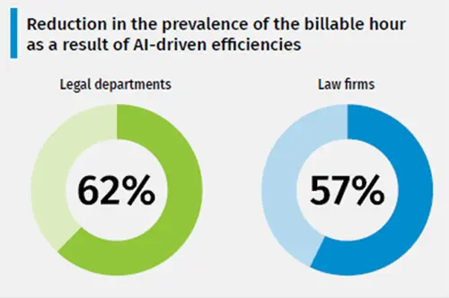
Figure 2. Reduction in the prevalence of the billable hour and AI trends [2].
The real tension to name: The economic distinction here is not simply between buying and building AI. It’s between building a tool for a single use case and building an institutional capability. A bespoke tool developed for one narrow task carries its full development and maintenance cost on a single workflow. A capability reused across clients, practices, and matters spreads that same fixed cost over a much larger base of work. At that point, AI stops being a technology expense and starts functioning as firm infrastructure — infrastructure that requires a new era of specialists to run.
The Hiring Curve and the Changing Docket
Beyond the headline numbers is a quieter story. This shift is not about the budget — it's about the roster. Tech hiring is visibly accelerating: Legal-AI job postings are reportedly up roughly 340 percent between January 2024 and January 2026, and 78 percent of Am Law 200 firms have created at least one AI-focused position. Traditional hiring has not been keeping the same pace — first-year associate classes are down at Am Law 100 and 200 firms in recent cycles. SurePoint Technologies’ 2026 Law School Hiring Report found new-associate hiring remained roughly flat over the prior three years despite strong revenue growth. It is too early to attribute that decline to AI alone; some of it predates generative AI at scale, and the evidence is better read as a change in hiring mix than a clean substitution rate.
Kirkland offers a live version of that mix inside a single firm: 180 technology professionals now sit alongside a platform built from the know-how of 250 lawyers, including 100 partners — a real, present-day ratio of technical to legal headcount inside one AI build-out. Linklaters shows a smaller but more deliberate version of the same shift: It launched Applied Intelligence, reportedly staffed at a ratio of three lawyers to three data scientists rather than the traditional model of assigning associates in proportion to a matter’s size.
The composition of the firm’s head count is shifting rapidly: more technical and specialist hires, a flatter, but still growing associate base.
Who Gets Cut — or Who Gets Hired?
Reed Smith’s 2022 appointment of anthropologist Dr. Madeline Boyer to lead its Innovation Lab is particularly revealing. Dr. Boyer’s academic background includes research on organizational culture and history of work, not primarily legal technology. That hire uniquely highlights innovation as a discipline of human behavior, organizational design, and collaboration, not simply a matter of software selection pipeline.
The traditional pyramid, for example, a large first-year class conducting document review, billed by the hour, is now compressing because AI removes that routine work. Similarly, on the business-services side, Baker McKenzie's cut of an estimated 600–1,000 business-services roles in February 2026, explicitly citing AI, is the largest AI-attributed cut in the legal industry to date.
The frame to land on is not necessarily fewer people but fewer types and more specialized roles. Fewer first-year associates and more AI-fluent paralegals, knowledge professionals, product managers, data scientists, and legal-operations specialists who operate and validate AI output. The new emerging architecture is not a replacement for legal talent, but a brand-new structure built around it. The old advantage was talent. The new advantage is talent combined with architecture. Firms that build the right team win the client.
From Technology Investment to Operating Model
These developments share a common direction: Competitive advantage is beginning to move beyond individual lawyers and the traditional partnership pyramid toward firm-owned workflows, proprietary technology, and interdisciplinary teams. Whether those investments become durable assets or expensive bets will depend on scale, reuse, and whether client pricing captures the value they create.
What is already clear is that the internal AI function is no longer a support function. As embedded teams move into the place where matters are scoped and delivered, practice management and legal operations move with them — helping select matters, assemble teams, price work, and convert one-off solutions into reusable infrastructure. This evolution is increasingly organizational, not merely technological. The question is no longer whether firms use AI, but how they are reorganizing around it.
References