Please enjoy this blog authored by Brendan Miller, Former AmLaw 100 Partner, Turned Legal Innovation Leader.
The ever-evolving demands for legal teams to deliver services more efficiently and more effectively, reliably, predictably, and in transparent fashion drive the need for teams to be thoughtful and diligent in how they use their time… and how they learn and grow. Developing and tracking precise team goals is mission-critical for law firms and legal departments to thrive in this environment.
AI AS YOUR TEAMMATE. 
As we’ve learned in countless ways as a legal community—particularly over recent years—AI has great potential, in this instance as a catalyst to transform traditional goal-setting practices into dynamic, data-driven processes. I am a proponent of the recent focus by a number of tech leaders, though, to plan beyond theconstruction of yet more “new” additional packaged use cases for AI. Use cases can facilitate understanding, but they also place artificial limiters on the power of a tool like AI. Instead, consider viewing AI as an additional subject matter expert for your team which you can call on for help throughout your goal setting and tracking process.
[For more on this topic generally, I highly recommend viewing the recent ILTA roundtable I was privileged to co-sponsor, The Right Stuff: Leadership Skills in the Age of AI (video session available to ILTA members), with a rockstar panel of Conor Grennan, Dan Hunter, Dr. Megan Ma, and moderator, Christine Dauchez.]
Below are suggestions on how you can pull a virtual chair up to your team table to engage AI in your goal setting and tracking efforts.
Note: These ideas are intended to be agnostic: adaptable to your preferred AI platform(s), technologies, team size/function, and organizational policies, practices and procedures. As always, please be sure to comply with your organization’s policies and practices for AI usage, including but not limited to anonymizing data as appropriate. Also—as is always the case in utilizing AI—you (a human!) are the ultimate arbiter of the value of AI outputs. Always remember to exercise independent judgment and maintain active awareness that any AI responses received may come with biases and/or hallucinations. AI prompting is best seen as an iterative process. (That’s a whole other topic beyond the scope of this blog, but there are plentiful resources available if you want to up your prompting game.) Regularly check along the way and adjust your prompts and/or data inputs, to ensure that the outputs are adding value for your team.

 SPRINGBOARD FOR GOAL BRAINSTORMING
AI can be used to generate an initial set(s) of goal ideas for your team, to serve as discussion points and “straw people” to test, affirm, define, or refine team priorities. Consider incorporating variables relevant to your team to hone the AI goal brainstorming output, by describing:
• Your team’s general function, and your firm or organization’s mission or leadership service areas
• Types of roles/ functions that exist within your team
• Your firm or organization’s vision and/or strategic priorities
• Circumstantial scenarios that could impact your team’s priorities or the scope of your work (e.g., budgetary, human resource or other organizational changes; external factors such as industry or clientele changes; etc.)
If using AI in this way, consider keeping a curated library of goal-setting prompts used to generate goal brainstorm sets. Capture and prioritize goal ideas in a shared backlog, for future reference. And, be sure to validate top ideas with leadership as part of your team’s formal goal adoption.
ADDITIONAL VARIATIONS
o For Larger Teams: Host department-level “innovation jam” days with rotating AI-facilitated breakout rooms to generate goal ideas
o For Smaller Teams: Use quick, informal AI chat sessions to gather goal ideas on the fl

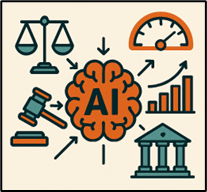 INDUSTRY BENCHMARKING FOR GOAL SETTING & MEASUREMENT
What are the major industry trends, emerging best practices, or factors that could or should be influencing your team’s goals? Your team can schedule periodic review sessions to compare internal versus benchmarked performance. Utilize AI to inform what your goals could be and the industry targets/standards against which you can measure your progress. In your AI queries, consider:
• Identify known industry leaders, surveys, or benchmarking tools
• Focus on measurables that matter; ask for metrics and provide examples of the types of metrics that would be most meaningful for your team’s work, based on your internal data sources; e.g. matter cycle times, realization rates, client satisfaction, compliance, tech adoption
• Pull and normalize peer metrics
• Run comparative “what-if” simulations
ADDITIONAL VARIATIONS
o For Larger Teams: Form a data-governance committee to manage benchmarking standards and data quality
o For Smaller Teams: Partner with peer firms or departments to share anonymized metrics and insights

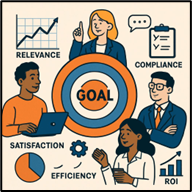 CRAFTING GOALS FOR DIVERSE STAKEHOLDER GROUPS
Stake hold er. noun. : “a person with an interest or concern in something”
A team’s most impactful goals are those that accurately account for the interests or concerns of relevant stakeholders. AI enables teams to virtually step into the shoes of their stakeholders and align goals accordingly. Much has been written and discussed about the role of persona building in AI prompting, and this functionality can serve the purpose of building team goals that resonate with diverse stakeholders. Consider:
• Inventory key stakeholder groups for your team; e.g. partners, associates, legal ops, clients, business units
• Query AI for key general interests for each stakeholder group
• Select and interview key stakeholders and develop a refined list of priorities, interests, or concerns; pair interview learnings with historical data
• Build a descriptive persona model/profile for each key stakeholder group and ask AI to develop goal sets for your group, including relevant Key Performance Indicators
• Test the AI personal models and goals sets against your stakeholder interviews, and refine accordingly
ADDITIONAL VARIATIONS
o For Larger Teams: Run joint workshops to build deeper, reined stakeholder persona models, map commonalities and interdependencies between teams and avoid goal conflicts
o For Smaller Teams: Conduct one-on-one goal calibration meetings using AI-generated suggestions as a starting point

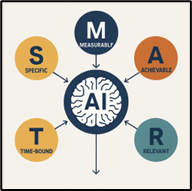 BUILDING SMART GOALS
Many of us are familiar with the SMART goals rubric, as a framework for developing goals that are concrete and set the individual or team up for success. As a brief reminder of the SMART system:
Specific: precise deliverables (e.g., reduce NDAs from 7 to 4 days)
Measurable: quantifiable; capable of being captured through available metrics and data sources
Achievable: peer/historical benchmarking ensures realism
Relevant: alignment to strategic objectives
Time-bound: AI-recommended timelines
AI can speed the process of converting general goals to SMART form. Once you’ve drafted preliminary goals or at least goal areas, query AI to refine your statements into SMART goal format. Consider:
• If your team has a preferred goal format, describe and/or provide and example of the form in your query to maximize the relevance of AI’s output
• Ask AI for multiple variants of SMART goals, to foster discussion and broader considerations
• Include any relevant timeframes for your goals (e.g. one month, quarterly, 6-months, one year, etc.)
• Be sure to review AI outputs to validate the format and content
• Take the next steps on SMART goals: ask AI to generate a proposed timeline and milestones for achievement of each SMART goal
ADDITIONAL VARIATIONS
o For Larger Teams: Standardize SMART goal templates across teams for consistency
o For Smaller Teams: Use a simple spreadsheet linked to AI suggestions for quick iteration

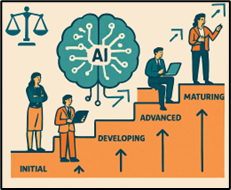 SCALING GOALS
Teams (and individual) goals tend to evolve over time. This may be due to changed environmental conditions, individual or team growth, changes in strategy, or other reasons. Goals may need to evolve from initial/ beginner stage, to maintenance, to stretch goals that push performance to new levels. AI can help teams to scale their goals to align with these changes.
Consider feeding an existing goal set to AI and:
• Asking for the goals to be adjusted by X% increase in performance
• Describe the factors driving the desire to adjust the goals, and ask for revised goals that aligned with the new drivers
• Ask for a new set of tiered goals for each existing goal. Define each goal tier (e.g. maintain, stretch, revolutionary) and describe any particular goal elements you are most interested in tweaking (e.g. timeframes, quantity of output, increased penetration, greater satisfaction, etc.).
ADDITIONAL VARIATIONS
o For Larger Teams: Review and recalibrate goals quarterly; create internal “goal ambassadors” to coach each tier and maintain momentum
o For Smaller Teams: Use biweekly check-ins to manually assess whether to push toward a stretch goal

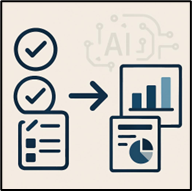 TURNING GOAL TRACKING INTO KPI AND ROI REPORTS
Goals are a fantastic tool for focusing and managing a team’s work, but their full value is realized when successes and learnings from those goals are shared. If your team has gone through the effort of forming goals and put in place systems to collect data that informs progress on those goals, you have the raw materials to generate effective, informative, and dynamic reports for key stakeholders, organizational leaders, and even clients. And AI can help!
Consider (early on in your work cycle—don’t wait until the end!):
• Use stakeholder personas (as described above) and ask AI to craft a format for a one-page (or longer) report summarizing Key Performance Indicators (KPIs) and demonstrating Return on Investment (ROI), and suggesting data points for your team to track and include in the report; automate reports on a quarterly basis
• Describe key data sources and data points your team uses in your day-to-day work and ask AI to identify KPIs you can use in a report for key stakeholders, and/or ask for suggestions on how the data might be displayed in a dashboard for key stakeholders
• Ask AI for suggestions on qualitative measures relevant to your team’s goals that you should consider including in stakeholder reports
• Pull together a spreadsheet used for tracking your team’s goal achievement. Share the spreadsheet data with AI and ask for suggestions on converting the data to an impactful slide deck to summarize progress and insights on team performance; tailor the output by defining the stakeholder(s) you are targeting
• Feed your team’s goal set to AI and ask for ideas on metrics that would demonstrate ROI for your team’s related activities
• Use AI to generate quarterly ROI forecasts and narrative summaries
ADDITIONAL VARIATIONS
o For Larger Teams: Deploy a centralized reporting team to oversee data integrity and distribution
o For Smaller Teams: Start with a single, high-impact dashboard and expand as you gain buy-in
There are lots of possibilities for AI to help your team develop, track, and leverage goals to achieve success. From having another source to help with simple brainstorming, to harnessing data on your team’s goals and achievements to tell your story to relevant stakeholders. The opportunities to view and utilize AI’s potential as another teammate on your team are only growing. My hope is that you might be able to integrate one or more of the ideas above to further enhance and reflect your team’s impact!
Brendan W. Miller, J.D. is a legal innovator: a curious, seasoned litigator and corporate attorney, technologist, strategist, and change agent. To Brendan, legal innovation is about continually being relevant for clients, by making the practice and effects of law easier, better, and more valuable.
#Leadership
#Automation
#ArtificialIntelligence
#200Level
#GenerativeAI
#BlogPost