Please enjoy this blog authored by Ricci Masero, Marketing Manager, Intellek.
The TJ L&D Influence Report 2026 carries a blunt message: most L&D teams are stuck measuring activity when they should be measuring effectiveness and impact. Based on responses from industry practitioners, the report maps where the profession currently stands and where it needs to be heading. The fix isn't complex. Get closer to the business. Use evidence that the business already trusts. Stop producing content for its own sake and start enabling performance in the flow of real work.
The headline finding? Only one person out of 32 respondents said they feel "very ready" to turn evidence into action. That's 3%. Everyone else is somewhere between hoping and struggling. The biggest blocker isn't tools or budget - it's access to the people who make decisions. L&D keeps solving problems it wasn't invited to diagnose.
Why L&D Keeps Getting Left Out of the Room
When business pressure rises, L&D often retreats into familiar ground: building programmes, creating content, running courses. It feels productive. It isn't always useful.
The report makes this tension visible. Respondents were asked what conversations L&D needs to start having with the business. The answers clustered around one theme: L&D needs to be in the room before the brief arrives, not after. One delegate put it plainly, "Involve us at the beginning of any conversation about change, projects, new roles."
That sentence captures a real structural problem. L&D is often a downstream function. It receives requests, builds solutions, and delivers training. The business moves on. Impact gets hard to trace because L&D was never close enough to the outcome in the first place.
Proximity changes that. When L&D works alongside the people who own results - operations leaders, commercial teams, HR business partners - it can shape what gets built before a brief ever lands. That's where influence starts.
What Actually Blocks L&D from Proving Its Value?
The report uses a four-part Readiness Enablers Index to pinpoint where the evidence-to-action chain breaks down. The four enablers are:
Access to decision makers on strategy, budget, and priorities
Access to usable data - performance, HR, business metrics
Time and permission to experiment
Tools and support to scale what works
When respondents scored themselves across all four, access to decision-makers came out as the most common bottleneck. Not tools. Not data. People. Specifically, the right people at the right time.
This matters because a lot of L&D investment goes into learning management systems, content libraries, and measurement frameworks. This suggests that investment is secondary. If you can't get in front of the people who own business outcomes, all the data in the world won't move the needle.
Andrew Jacobs, quoted in the report, names the emotional barrier underneath this: "What happens if what we do doesn't actually make any difference?" That fear of measurement is real. But the report reframes it - evidence isn't a verdict, it's a conversation starter.
Is L&D Focused on the Right Business Problems?
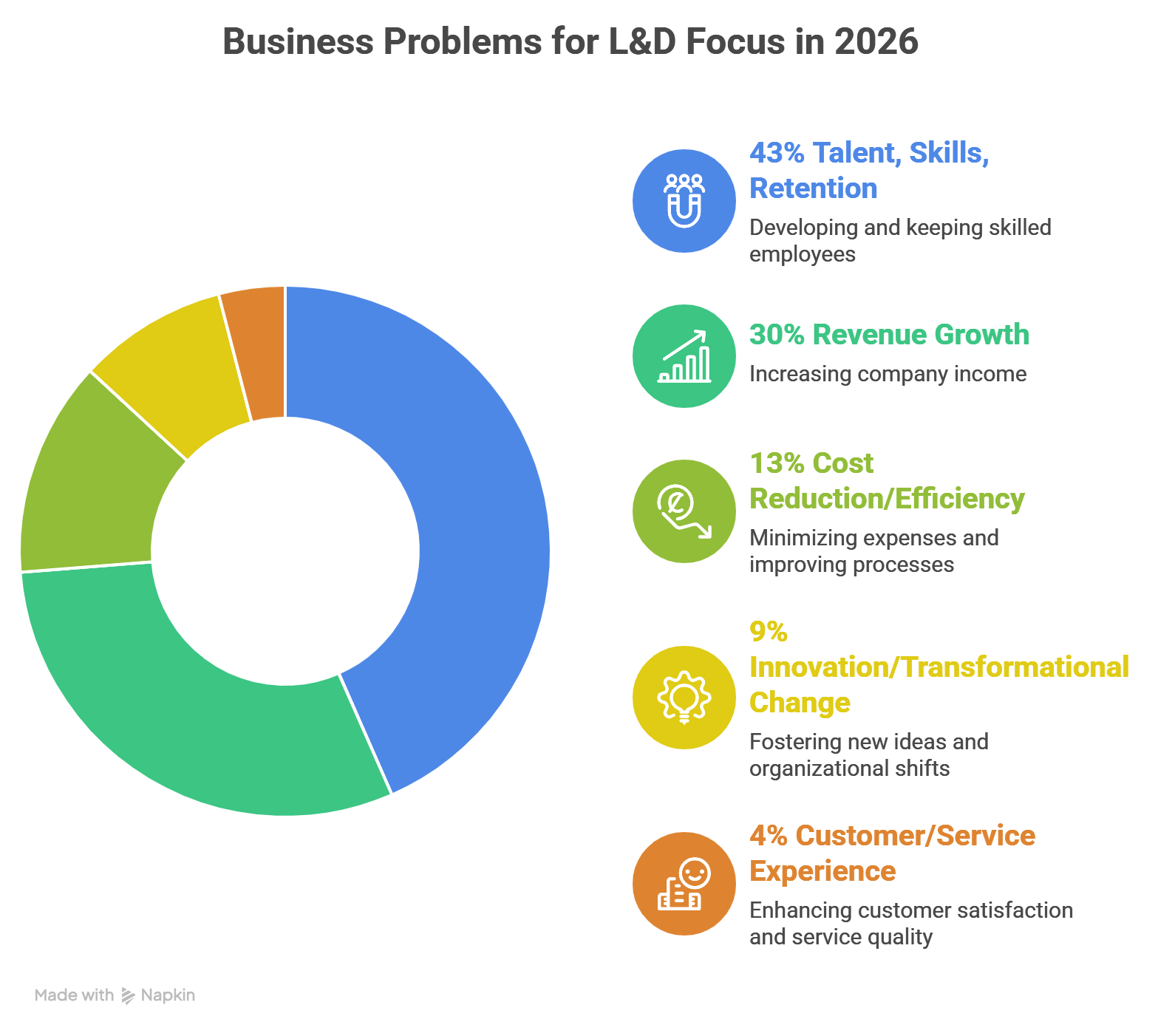
When asked what results L&D needs to focus on in 2026, respondents answered clearly:
43% talent, skills, or retention
30% revenue growth
13% cost reduction or efficiency
9% innovation or transformational change
4% customer or service experience
Talent and retention dominate. That's not surprising given the labour market pressures the report describes - rising cost of living, demographic change, geopolitical uncertainty. What's interesting is how few respondents connected L&D's work to revenue growth. Only 30% saw that as the primary focus, yet most business leaders would rank revenue as their top concern.
NOTE: This gap between L&D's framing and business leadership priorities may be a contributing factor to L&D's lack of strategic influence - the report doesn't explicitly make this connection, but the data supports it.
L&D speaks learning. Business speaks outcomes. That language gap is where strategic relevance gets lost.
What Does "Performance Enablement" Mean in Practice?
The report draws a sharp line between delivering learning and enabling performance. One delegate said it directly: "Impact. It's ALL about impact and what we do which impacts on the business bottom line, not how good our learning content is."
Performance enablement means removing friction from real work - not designing another module. In practical terms, that looks like:
Job aids and checklists that sit inside the workflow, not in a learning system
Manager coaching loops that happen weekly, not once a year in a review cycle
Process fixes that remove approval bottlenecks or tool friction
Clear performance standards so people know what good looks like before they're assessed on it
What Should L&D Stop Doing Right Now?
This is the section most L&D teams avoid. The report is direct: stopping activity is a strategic act, not a failure.
There are three categories of work - worth keeping, dropping, or doubling down on.
Keep work that is co-owned with outcome leaders, requested early, and measured in business terms.
Drop activity that exists because it's familiar or popular - training that is easy to produce but hard to connect to any business result.
Permission to say “no” protects work capacity that actually changes performance. Without that discipline, L&D stays busy and stays invisible.
How Do You Build an Experiment-Ready L&D Function?
The report identifies time and permission to experiment as one of the four core enablers - and one of the most commonly missing. Practitioners described feeling stretched, reactive, and unable to step back long enough to test new approaches.
One delegate captured the mindset shift needed: "We must become evidence-informed practitioners… from which we can experiment and adapt to the changing world."
That doesn't mean running complex research projects. It means picking one small question, designing a simple test, and agreeing up front what "success" looks like. The report recommends a focused 30-day sprint as a starting point - meet two or three outcome owners, define two or three success signals, enable one workflow with performance support, and run one experiment.
Small cycles build evidence. Evidence builds confidence. Confidence earns influence.
The Profession Isn't Broken - It's Just Too Quiet
L&D has never lacked ideas, tools, or commitment to people. What it has lacked is visibility. The TJ L&D Influence Report 2026 doesn't diagnose a broken profession - it describes a capable one that keeps underselling itself to the people who most need to hear from it.
The data is clear. The blockers are known. The path forward isn't complicated - get closer to the business, agree on what success looks like before the work starts, and have the courage to stop what isn't working. That's not a transformation programme. That's a choice you can make this week.
The profession moves when practitioners move first. Read the full research, share it with someone who owns outcomes in your organisation, and use it to start a conversation you've been putting off.
Download The TJ L&D Influence Report 2026 directly from Training Journal - and find out exactly where your readiness bottleneck is before someone else decides it for you.
#Just-in-Time#BlogPost#LearningManagement#FutureFocused#eLearning